What Is Civilization?

Picture a single farmer standing in a muddy field at the edge of a river. For the first time in history, one man can grow enough grain to feed five people. One farmer, five mouths. Before him, every person alive spent the whole day hunting and gathering just to survive — no time to build, no time to write, no time to make anything that lasted.

Key Terms

Civilization
From the Latin civitas, "city-living"; a society with cities, social hierarchy, and a central authority.
Irrigation
Bringing water to dry land through hand-dug canals and trenches so crops can grow.
Pyramid
A colossal, smooth-sided stone tomb built by the Egyptians for their divine pharaohs.
Citizen
A member of the civitas — the "body of citizens" the word civilization comes from.
Virtue
Excellence forged through effort — what the Greeks would later call aretē.
Civitas
The Latin word we get "city" and "civilization" from — a society, or "city-living."
Mud bricks
Clay pressed in wooden molds and dried in the hot sun — Mesopotamia's building material.
Agricultural Surplus
Extra grain beyond what is needed
Division of Labor
Different jobs for different people
Ziggurat
A temple-mountain of baked mud brick

From the Lesson 1 Visual Atlas
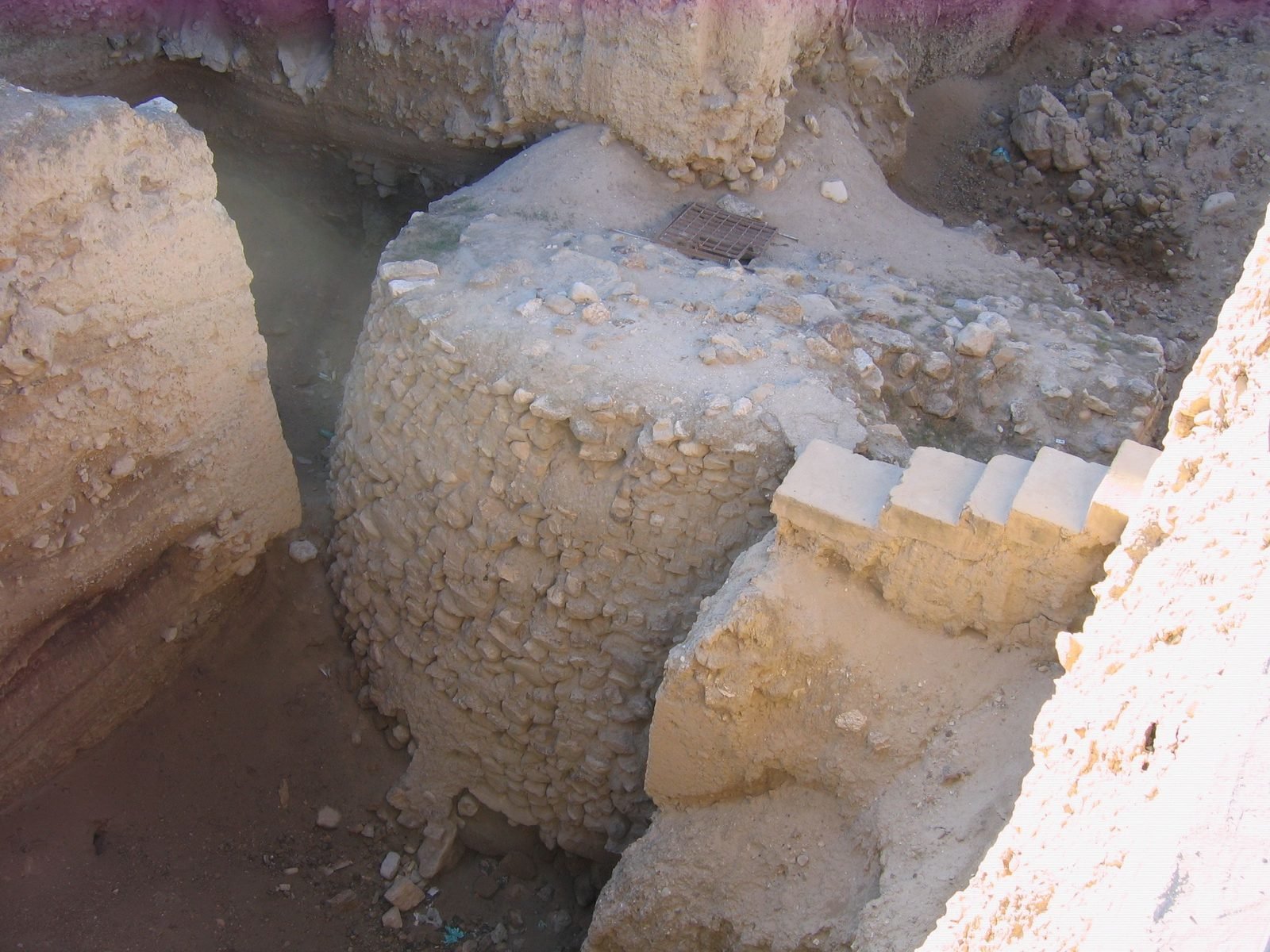
The stone tower of Jericho at Tell es-Sultan, near the Jordan River, seen from above in its excavation trench. Built about 8000 BC — before a single brick was laid in Mesopotamia — it stands about 28 feet, five men on each other's shoulders, with a staircase inside. This plate is dated five thousand years before the rest of the lesson on purpose: it is the near-miss. A wall, a tower, maybe two thousand people. Ask three questions — could one farmer feed anyone but his own family, did anyone have a job besides growing food, could anyone prove what he owned — and Jericho fails all three. Town, not city.
c. 8000 BCThe stone tower of Jericho at Tell es-Sultan, near the Jordan River, seen from above in its excavation trench. Built about 8000 BC — before a single brick was laid in Mesopotamia — it stands about 28 feet, five men on each other's shoulders, with a staircase inside. This plate is dated five thousand years before the rest of the lesson on purpose: it is the near-miss. A wall, a tower, maybe two thousand people. Ask three questions — could one farmer feed anyone but his own family, did anyone have a job besides growing food, could anyone prove what he owned — and Jericho fails all three. Town, not city.
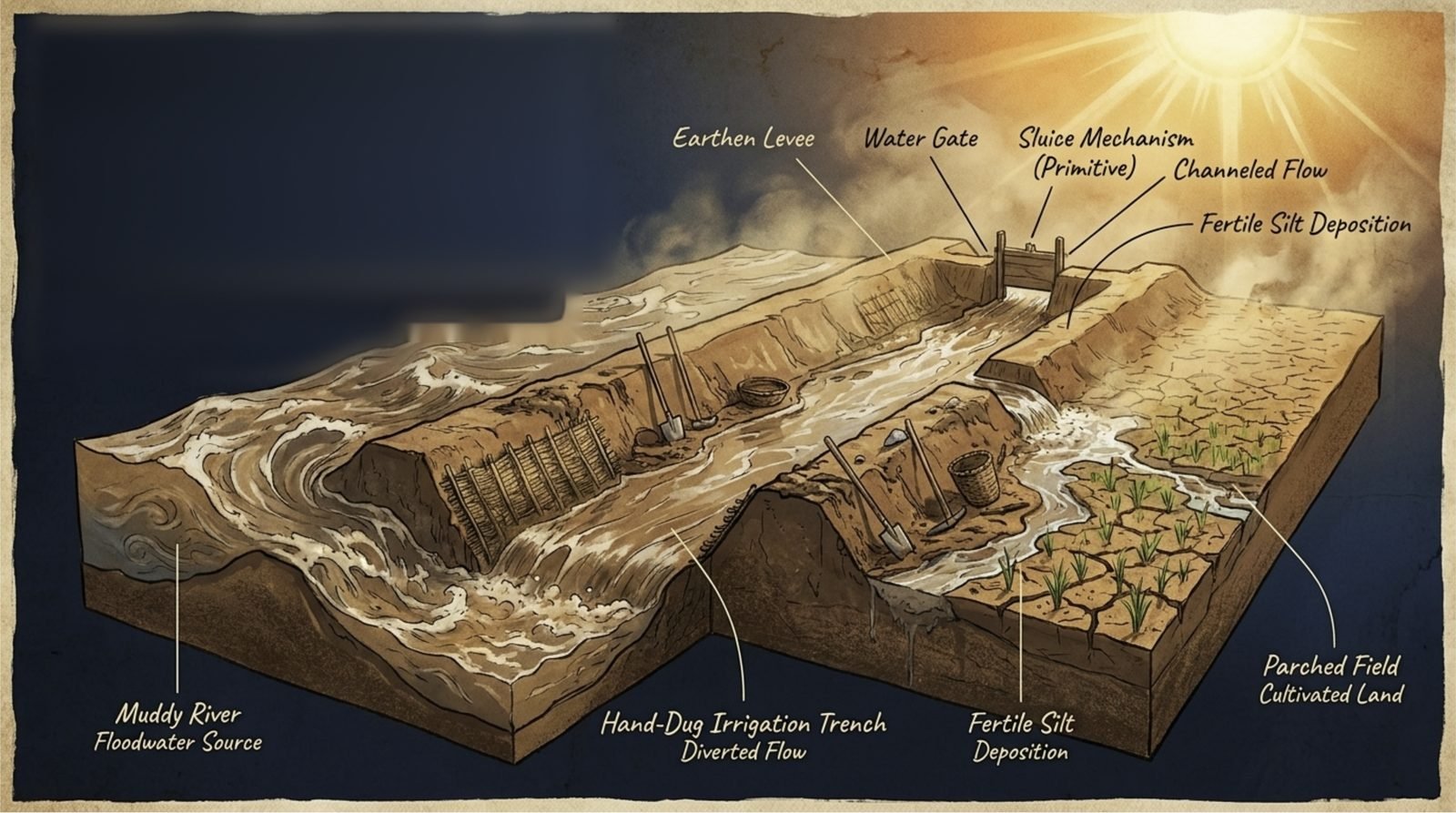
Taming the flood. In the lower Mesopotamian plain the Tigris and Euphrates flooded every spring. A cutaway of a hand-dug irrigation trench: an earthen levee holds the muddy river back, a simple sluice gate lets it through, and the channel carries water and fertile silt across a parched field until barley stands in it. Every foot of this was dug with wooden hoes and hauled out in baskets — and it only worked if every farmer along it cleared his own stretch each season. This is the choice the whole lesson turns on: run, or dig.
c. 3000 BCTaming the flood. In the lower Mesopotamian plain the Tigris and Euphrates flooded every spring. A cutaway of a hand-dug irrigation trench: an earthen levee holds the muddy river back, a simple sluice gate lets it through, and the channel carries water and fertile silt across a parched field until barley stands in it. Every foot of this was dug with wooden hoes and hauled out in baskets — and it only worked if every farmer along it cleared his own stretch each season. This is the choice the whole lesson turns on: run, or dig.
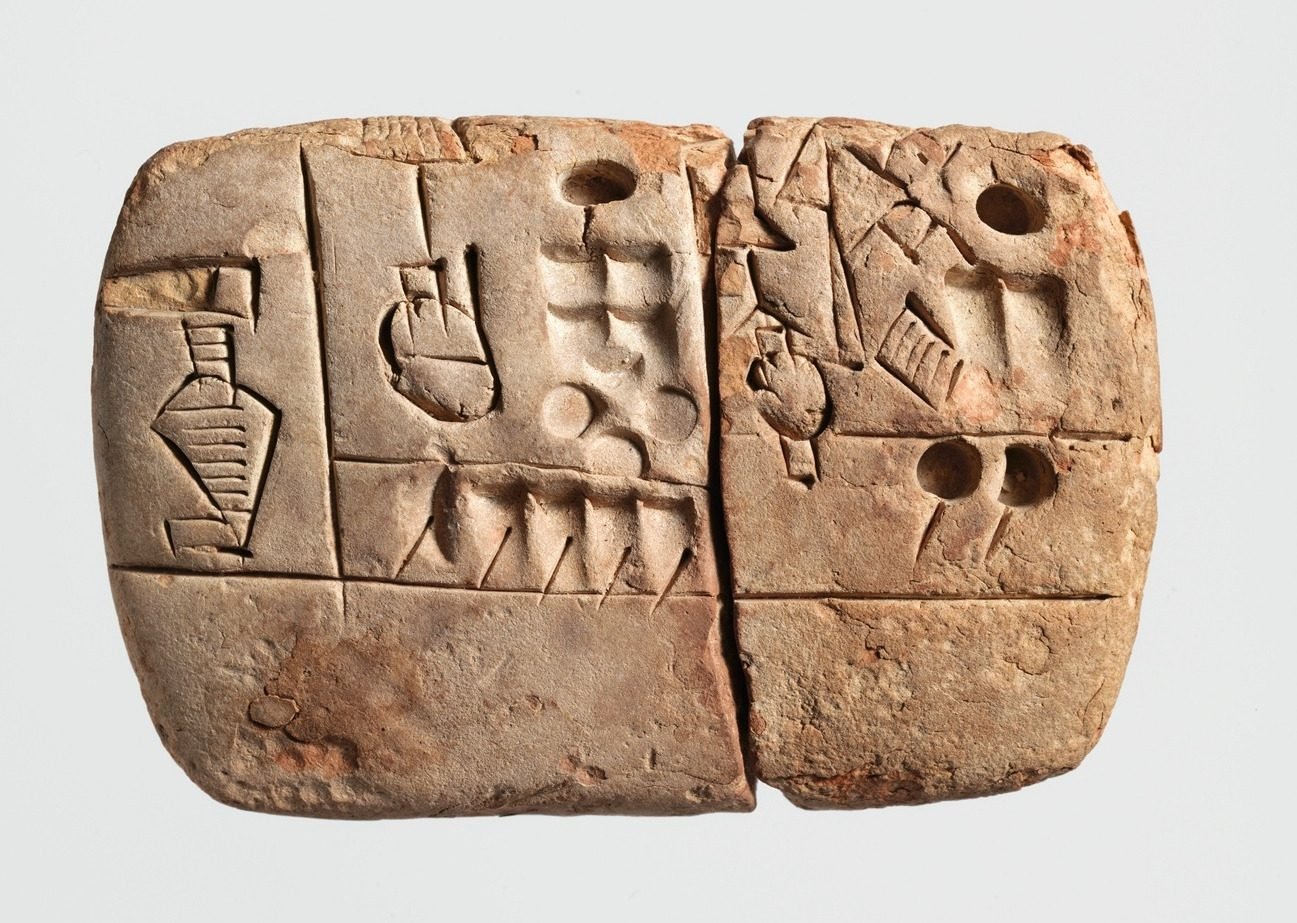
A clay tablet from Uruk, about 3100–2900 BC, small enough to sit in your palm, now in the Metropolitan Museum of Art. The signs are drawn, not yet pressed in wedges: a jar, a head, and rows of circles and notches that are numbers. It is an account of malt and barley handed out by a large temple — not a poem, not a prayer. The oldest writing in the world is a grain ledger. A tablet like this is how a city of forty thousand could prove who owned what.
c. 3100–2900 BCA clay tablet from Uruk, about 3100–2900 BC, small enough to sit in your palm, now in the Metropolitan Museum of Art. The signs are drawn, not yet pressed in wedges: a jar, a head, and rows of circles and notches that are numbers. It is an account of malt and barley handed out by a large temple — not a poem, not a prayer. The oldest writing in the world is a grain ledger. A tablet like this is how a city of forty thousand could prove who owned what.
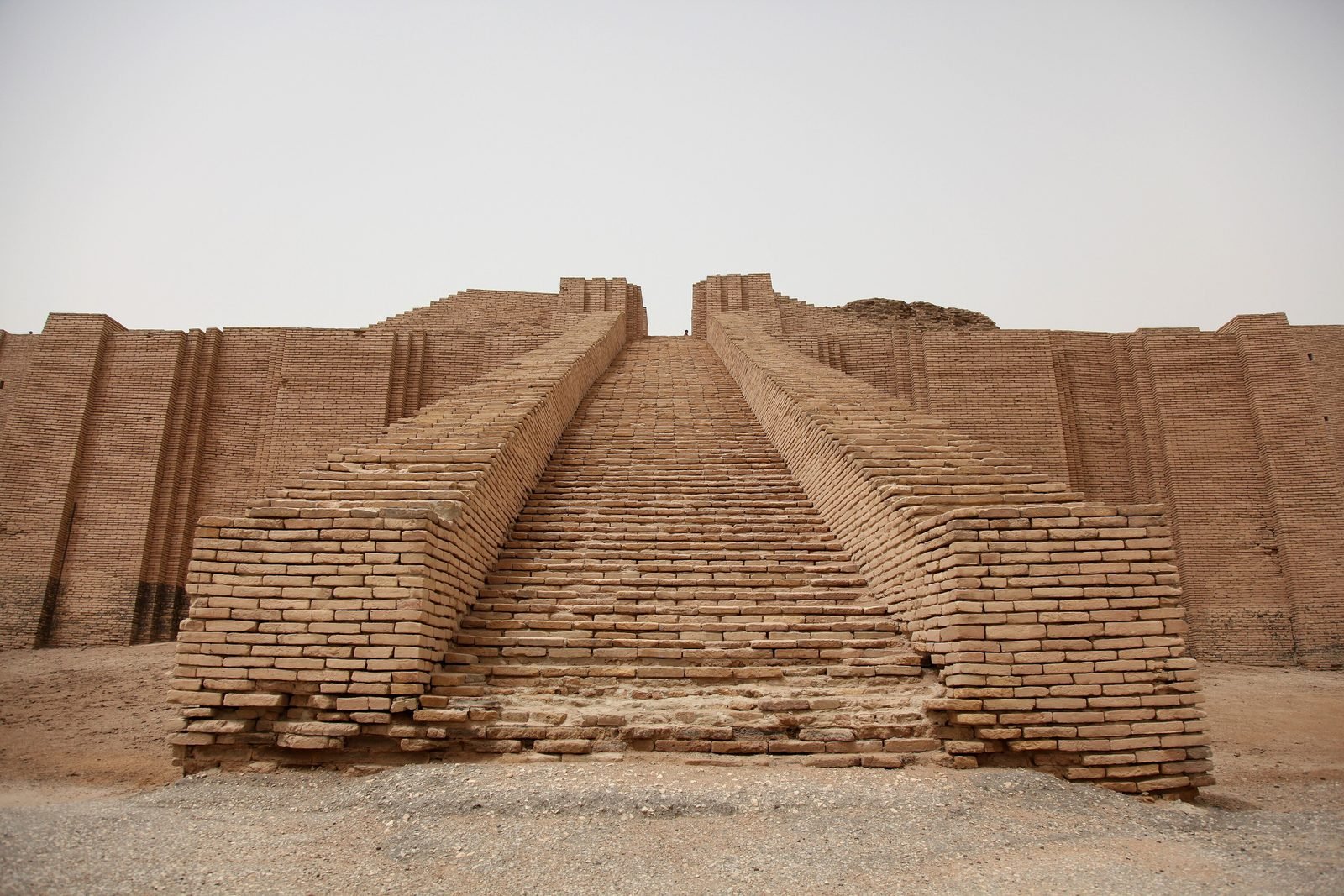
The Great Ziggurat of Ur, looking straight up the central staircase, built about 2100 BC. Three stairways of about a hundred steps each meet at a gate on the first terrace; behind them the platform is a solid mountain of some seven million sun-dried bricks under a skin of baked brick. On a floodplain with no stone and no timber, this is what mud can do when a king can command the labor of a whole city. The lower facing and this stair were rebuilt on the ancient core in the 1980s; the mass behind them is the original.
c. 2100 BCThe Great Ziggurat of Ur, looking straight up the central staircase, built about 2100 BC. Three stairways of about a hundred steps each meet at a gate on the first terrace; behind them the platform is a solid mountain of some seven million sun-dried bricks under a skin of baked brick. On a floodplain with no stone and no timber, this is what mud can do when a king can command the labor of a whole city. The lower facing and this stair were rebuilt on the ancient core in the 1980s; the mass behind them is the original.